Certificate of Origin Application Checklist: 30 Checks Before You Apply
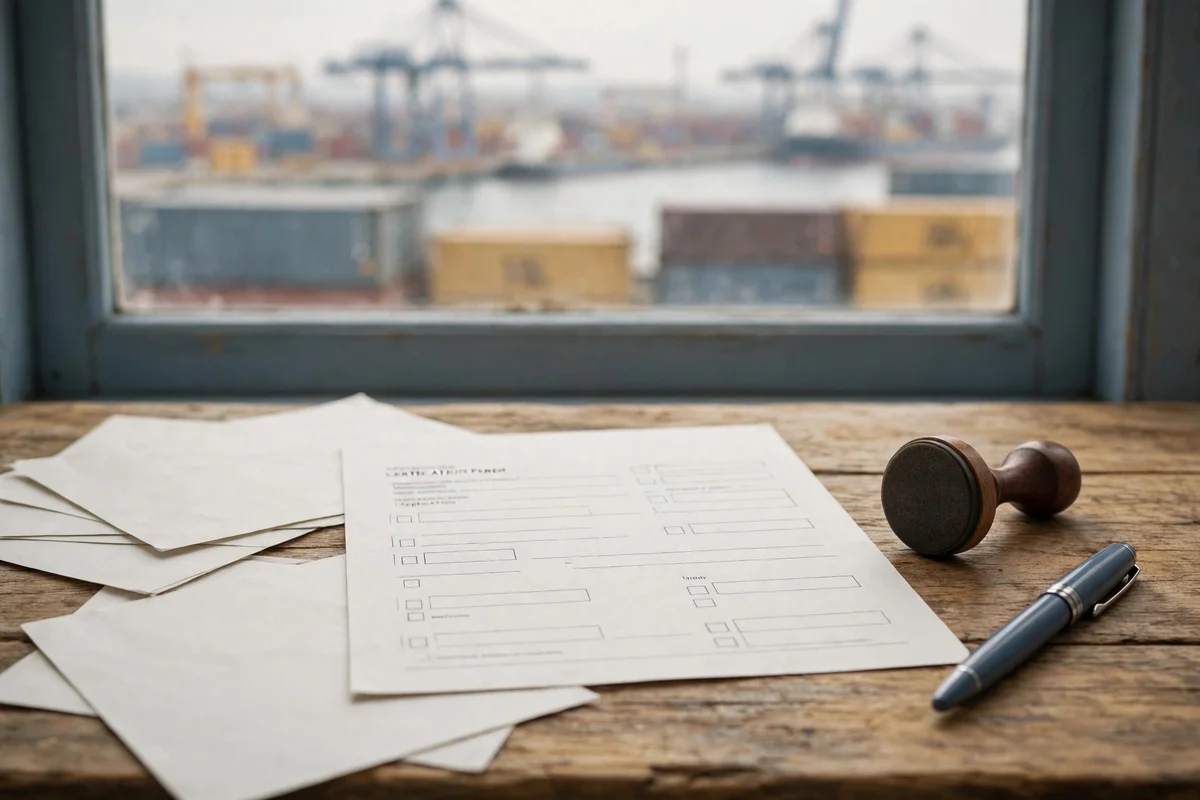
A certificate of origin states where goods were made, and a wrong name, a missing paper, or a form field that does not match the invoice is a common reason an application is sent back. This checklist lists thirty checks in four stages, to complete before the application is filed.
How to use this checklist
This page covers the certificate of origin application only: the checks to complete before the application is filed — the origin facts, the papers that prove origin, the application form, and the filing itself. It does not repeat the international shipping documents checklist on this site, which lists the certificate of origin as one paper among many in a shipment file. It does not repeat the export customs declaration elements checklist, which checks the origin field on the declaration. It does not repeat the export declaration rejection checklist, which covers the reasons a filed declaration is turned back. Use this page to prepare the certificate application; use those pages for the full documents list, the declaration fields and the rejection reasons.
Work through the four stages in order, with the commercial invoice, the packing list and the maker statement open beside this page. Read each field on the application against the same field on the invoice and the packing list, and ask, for each paper, whether it proves what the application states. Where a paper is missing or a field differs between two papers, mark it on the file and ask the issuing office in writing what it needs before the application is filed.
The exporter states the origin, the maker proves where the goods were made, and the issuing office checks the papers and stamps the certificate, so an error can enter at any of those three points. Ask for every fact, paper and signature in writing before the application is filed, and keep the written answers with the application file.
Stage 1 — Origin facts first
Stage 1 covers the facts the whole application rests on: where the goods were made, and what changed there. A wrong place of manufacture, or a goods description that does not match the invoice, is the error most often found on a returned application.
Read the place of manufacture and the goods description on the application beside the same fields on the invoice and the packing list, and ask whether a stranger could tell where the goods were made from the application alone. Where parts came from more than one place, name the place of the last real change. Where the maker cannot state the place in writing, stop and ask the maker before the application is filed.
Stage 2 — Papers that prove the origin
Stage 2 covers the papers that support the origin stated on the application: the invoice, the packing list, the maker statement, and the supplier papers for parts from other places. An origin statement without papers to support it is an error on its own.
Gather every paper the issuing office asks for, and read each one against the application to see whether it proves what the application states. Where a paper is missing, ask the maker or the supplier for it in writing. Where a paper states a different place from the application, stop and ask the maker in writing which version is right. Keep a copy of every paper filed, so the file can be checked again without asking the maker twice.
Stage 3 — Filling in the application form
Stage 3 covers the form itself: every field filled, every name spelled the same as on the invoice, and the declaration statement signed. A form field that differs from the invoice, or a signature missing from the declaration statement, is a common reason an application is sent back.
Fill in the form from the invoice and the packing list, not from memory, and read the whole form once more from the first line to the last before signing. Check the country of origin, the goods description and the marks against the invoice, and check that the stamp sits clear inside the box where the form asks for it.
Stage 4 — Filing, collection and keeping the certificate
Stage 4 covers what happens after the form is signed: filing with the right office, checking the issued certificate on collection, and keeping the original with the shipment papers. A certificate that is not checked on collection can travel with an error no one noticed.
File the application with the office that issues certificates for the place of manufacture, and keep a copy of the filed application with the invoice and the packing list. On collection, read the names, the origin, the goods and the marks on the certificate against the application, and report any error to the issuing office in writing at once.
Which origin paper should be prepared first?
Every application has one paper that needs the closest look, and it depends on the goods: goods made in one place need the maker statement first, goods made from parts from more than one place need the supplier papers first, an application sent back for a wrong name needs the form first, and a certificate already issued with an error needs the issued certificate first. The table points to the right stage for each case.
| Case | When it applies | What to check first |
|---|---|---|
| Goods made in one place | The maker and the place of manufacture are the same, and the invoice agrees | Start at Stage 1, confirm the place of manufacture with the maker in writing, and attach the maker statement |
| Goods made from parts from more than one place | Parts came from other places before the last real change | Start at Stage 2, gather the supplier papers for those parts, and name the place of last real change |
| Application sent back for a wrong name or field | The form states a name or a field that differs from the invoice | Start at Stage 3, fill in the form from the invoice, and read the whole form once more before signing |
| Certificate already issued with an error | The issued certificate states an origin or a name that the application does not | Start at Stage 4, report the error to the issuing office in writing, and keep the corrected certificate with the file |
Common reasons certificate applications are sent back
Most certificate applications are sent back for the same few causes. The place of manufacture on the application differs from the place on the invoice, so the issuing office cannot tell which version is right. The maker statement is missing, or it is signed by someone other than the maker, so the origin has no paper to support it. A field on the form is left blank, or a name is spelled one way on the application and another way on the invoice, so the papers do not agree with each other. The goods description is a trade name only, so the reader cannot tell what the goods are.
The fix is the same in each case: state the place of manufacture in plain words, attach the maker statement signed by the maker, and read the application against the invoice and the packing list line by line before the application is filed. Write the plain description beside any trade name, check the country of origin against the maker statement, and ask the issuing office in writing where a paper is still in question. Keep the written answer with the application file, so the next application starts from a correct file rather than a copied one.
What this checklist cannot decide
This checklist cannot decide which place counts as the origin for a given product, or which papers an issuing office will accept: those follow the goods themselves, the place of manufacture and the office that issues the certificate. It cannot say whether an application with an error will be sent back, and it cannot set the application result: that follows the papers and the issuing office check.
It also cannot replace the issuing office advice on a specific application. Where a request names a paper this checklist does not cover, or an origin is disputed, ask the issuing office in writing before the next step. It cannot file an application for goods never booked, and it cannot turn a certificate issued with the wrong origin into a correct one without a fresh check of the papers.
Export guides on this site
- International Shipping Documents Checklist: Export, Transport & Customs Clearance
- Export Customs Declaration Elements Checklist: Pre-Filing Checks for Every Field
- Export Declaration Rejection Checklist: Common Return Reasons & Pre-Submission Checks
- Customs Broker Selection Checklist: License, Fees, Communication & Terms
- US Import Customs Declaration Errors Checklist: Common Mistakes to Spot Before Filing
- China to USA Import Documents Checklist: Invoice, ISF and Product Records
Related guides
- International Shipping Documents Checklist: Export, Transport & Customs Clearance
- Export Customs Declaration Elements Checklist: Pre-Filing Checks for Every Field
- Export Declaration Rejection Checklist: Common Return Reasons & Pre-Submission Checks
- Customs Broker Selection Checklist: License, Fees, Communication & Terms
- US Import Customs Declaration Errors Checklist: Common Mistakes to Spot Before Filing
- China to USA Import Documents Checklist: Invoice, ISF and Product Records
Official references
- US Customs and Border Protection: Trade
- ICC: Incoterms 2020
- FIATA: International Federation of Freight Forwarders Associations
- IATA: Cargo
For a route-specific logistics review, provide the product, origin, destination, packed dimensions, weight and ready date.
Request a shipment review ↗Frequently asked questions
What does a certificate of origin prove?
It states where goods were made, and it is issued by an authorised office after checking the papers that prove the origin. The buyer, the bank and the customs office at the destination read it to see the place of manufacture. It does not prove the quality of the goods, and it does not set the duty: those follow the goods themselves and the papers beside the certificate.
Who issues a certificate of origin?
A chamber of commerce or another office authorised to issue certificates for the place of manufacture. The exporter files the application with that office, with the invoice, the packing list and the maker statement attached. The office checks the papers against the application, and stamps the certificate where the papers agree with the application.
What happens if the certificate does not match the invoice?
The papers do not agree with each other, and the buyer or the customs office at the destination can ask for the error to be fixed. Report the error to the issuing office in writing at once, with the invoice and the application beside the certificate, and ask what the office needs to correct it. Keep the corrected certificate with the shipment file, and keep a copy apart from the original.