Dangerous Goods Air Freight Checklist: Documents, Packaging & Carrier Acceptance
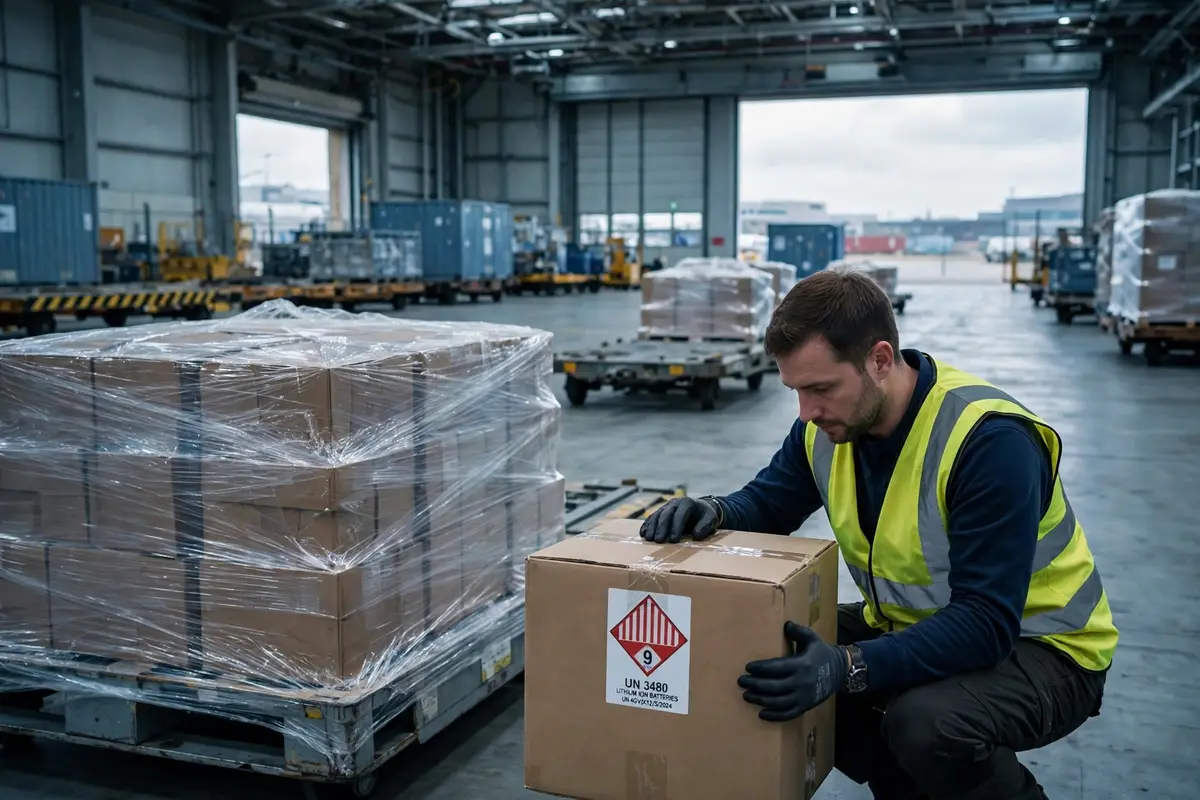
Before a dangerous goods shipment leaves for the airport, four things must line up: the goods are classified, the documents match the package, the package meets its packing instruction, and the carrier accepts the consignment. Work through this checklist in order, one stage at a time.
How to use this checklist
This page is a working tool, not a summary. Tick each item only when the named document or package is in front of you and has been checked against the entry. A tick means the item was verified, not that the shipment is approved: the carrier still runs its own acceptance check at handover, and only the carrier decides whether the consignment is accepted.
Work through the four stages in order: Stage 1 settles what the goods are, Stage 2 the paperwork, Stage 3 the physical package, and Stage 4 the handover. If an item in an early stage cannot be ticked, stop there: fixing a classification or a document after packing usually means opening the package and starting again.
Keep the finished checklist with the shipment file. If the carrier raises a query, it shows which checks were done and in which order, and whether the problem sits in the classification, the documents or the package. The same classification, packing instruction and document set usually apply when the same goods ship again.
Stage 1 — Before booking: confirm the goods
Nothing else in this checklist works until the goods are classified. Classification gives the UN number, the proper shipping name, the class or division, any subsidiary hazard and the packing group, and decides which packing instruction applies. It must be done by a trained person, using the safety data sheet and the current IATA Dangerous Goods Regulations (DGR), which apply the ICAO Technical Instructions to air transport.
Once the classification is known, check the route before booking. State variations and operator variations can add conditions or forbid a substance on a route or carrier, even when the DGR allow it in principle. A carrier may also refuse a class of goods entirely, or accept it only on certain aircraft types. Ask the carrier or forwarder whether the goods are accepted on the planned routing before confirming the booking, and record the answer.
Also confirm the quantity limits for the packing instruction. Air transport sets a net quantity limit per package, and the limit for passenger aircraft is often lower than for cargo aircraft only. A package packed above its limit must be split or repacked, not shipped as it stands.
Stage 2 — Documents: the declaration and the air waybill
The central document is the shipper's declaration for dangerous goods (DGD), signed by the shipper or by a trained person acting for the shipper. It states the UN number, proper shipping name, class, packing group, quantity, type of packaging and packing instruction for each entry, and states that the goods are fully and accurately described and are packed, marked and labelled as the regulations require. An error on the declaration is one of the most common reasons a shipment is held at acceptance.
The air waybill must carry the dangerous goods handling information, and its entries must agree with the declaration. For lithium batteries the UN38.3 test summary must be available: it shows the battery type passed the tests in the UN Manual of Tests and Criteria, and the carrier may ask for it before acceptance. Keep the test summary with the shipment file even when it is not attached to the declaration.
Any approval, exemption or special permit used for the shipment must be attached or referenced, and its conditions met in full. If the goods need a state approval, it must cover the exact goods, quantities and routing in the booking. A permit for a different routing or quantity does not cover the shipment in front of you.
Stage 3 — Packaging, marking and labelling
Dangerous goods for air transport must be packed in UN specification packaging where the packing instruction requires it, used exactly as its test approval allows: the right inner packagings, quantities, cushioning and absorbent material, and closures secured as the packing instruction directs. A package that looks sound but uses the wrong inner packaging or exceeds the inner quantity limit fails the packing instruction, even if the outer box is intact.
Marking and labelling must match the declaration. The package must show the proper shipping name and UN number, the shipper and consignee, and the UN specification mark where called for. Hazard labels must show the correct class or division, and handling labels such as orientation arrows and the cargo aircraft only label must be applied where required. Labels must be visible, not folded around a corner.
Check the package before it leaves the warehouse: the outer packaging must be undamaged, dry and strong enough for the journey, with closures secured and no leakage or odour. An overpack must be marked and labelled as an overpack, with the required marks and labels reproduced on the outside. If the package is damaged, wet or leaking, do not tender it: repack it and recheck it.
Stage 4 — Handover and carrier acceptance
At handover the carrier runs an acceptance check: staff compare the declaration with the packages, check the marks and labels, verify the packaging against the packing instruction and confirm the shipment matches the booking. This is the point where most errors are caught, and a shipment that fails it is held until the error is corrected.
If a discrepancy is found, correct it before the shipment is re-offered, and have the change made by a trained person. Do not ask acceptance staff to overlook a discrepancy: their check follows the DGR, and a shipment accepted with a known error puts the flight, the crew and the consignee at risk.
Keep a record of the acceptance outcome with the shipment file: the flight, the acceptance point and any query raised, so a repeat shipment of the same goods can be prepared with the same answers. Where the carrier holds a shipment, record the reason in the same place, because the same reason will hold the next shipment too unless the underlying check is changed.
Lithium batteries: Section IA, IB and II
Lithium batteries are the most common dangerous goods in air freight from China, and they have their own rules inside the DGR. Standalone lithium ion batteries ship under UN3480, and lithium metal batteries under UN3481 when packed with or contained in equipment. The packing instruction divides them into sections: Section IA and IB are fully regulated, both needing a DGD and a Class 9 hazard label, and differ only in the net quantity allowed per package. Section II is excepted from some full requirements: no DGD is needed and the lithium battery mark replaces the Class 9 label, but the package must still meet the packing instruction, the batteries must be protected against short circuit, and the UN38.3 test summary must still be available.
The section is decided by the battery type and the quantity per package, not by the shipper's preference. Read the watt-hour rating for lithium ion batteries, or the lithium content for lithium metal batteries, then read the packing instruction for the exact entry. A battery above the Section II limit moves into Section IB or IA, and the document and labelling requirements move with it. Getting the section wrong is a common cause of holds, because the DGD, the label and the package then disagree.
Two more rules apply to every lithium battery shipment. First, the state of charge for standalone lithium ion batteries shipped by air is limited to 30 percent of rated capacity, unless an approval allows otherwise. Second, damaged, defective or recalled batteries are forbidden for air transport: a battery that is swollen, leaking, hot or physically damaged must not be shipped at all. Vehicles and equipment powered by lithium batteries, such as electric scooters, golf carts and forklifts, ship under UN3171 where the entry applies, with the battery protected against short circuit and movement inside the equipment.
What this checklist cannot decide
This checklist covers the general requirements of the IATA DGR and the ICAO Technical Instructions. It does not cover a carrier's own embargoes, which can forbid a substance or battery type the regulations allow, or destination import rules, which can require a permit, a licence or a local registration before the goods arrive. Both must be checked separately for the route in front of you.
The checklist also does not classify goods. Classification of a new substance, a new battery chemistry or a mixture needs a trained person and, where the regulations call for it, test data. If the safety data sheet does not give a clear classification, ask the manufacturer or a qualified dangerous goods adviser before booking, and do not guess the UN number from a similar product.
Why shipments are held at acceptance
Most holds come back to the same few errors. The declaration and the package disagree on the UN number, the proper shipping name, the packing group or the quantity. The wrong packing instruction was used, or the right one with the wrong inner packaging. The UN38.3 test summary is missing for a lithium battery shipment. The package is damaged, or a label is missing, wrong or folded out of sight. Or the goods were not declared as dangerous at all, and a screening check finds them.
Dangerous goods guides on this site
- Dangerous Goods Air Freight from China: Complete Guide
- Dangerous Goods Pre-Booking Review for China Shipments
- Lithium Battery Shipping from China: Complete Guide
- UN38.3 Lithium Battery Certificate from China
Related guides
- Dangerous Goods Sea Freight Checklist: IMDG Booking & Handover
- Dangerous Goods Air Freight from China: Complete Guide
- Dangerous Goods Pre-Booking Review for China Shipments
- Lithium Battery Shipping from China: Complete Guide
- Air Freight from China: Complete Guide
Official references
For a route-specific logistics review, provide the product, origin, destination, packed dimensions, weight and ready date.
Request a shipment review ↗Frequently asked questions
What documents must accompany a dangerous goods air shipment?
The shipper's declaration for dangerous goods (DGD), signed by a trained person, is the central document: it states the UN number, proper shipping name, class, packing group, quantity, packaging type and packing instruction. The air waybill must carry the dangerous goods handling information and agree with the declaration. For lithium battery shipments the UN38.3 test summary must also be available, and any approval, exemption or permit used must be attached or referenced with its conditions met.
What is the difference between Section IA, IB and II for lithium batteries?
Section IA and Section IB are fully regulated: both need a DGD and a Class 9 hazard label, and they differ in the net quantity allowed per package, with Section IB covering smaller quantities. Section II is excepted from some of the full requirements: no DGD is needed and the lithium battery mark replaces the Class 9 label, but the package must still meet the packing instruction, the batteries must be protected against short circuit, and the UN38.3 test summary must still be available. The section is decided by the battery type and the quantity per package.
Can a carrier refuse a dangerous goods shipment that is packed correctly?
Yes. Packing to the DGR is necessary but not always enough: the carrier runs its own acceptance check and may apply operator variations or embargoes that forbid a substance or battery type on a route or aircraft. It may also refuse a shipment where the documents and the package disagree, or where a required approval or test summary is missing. Check the carrier's acceptance policy before booking, not at handover.