UN-Approved Packaging for Dangerous Goods from China: Marks, Tests and the DG Packaging Certificate
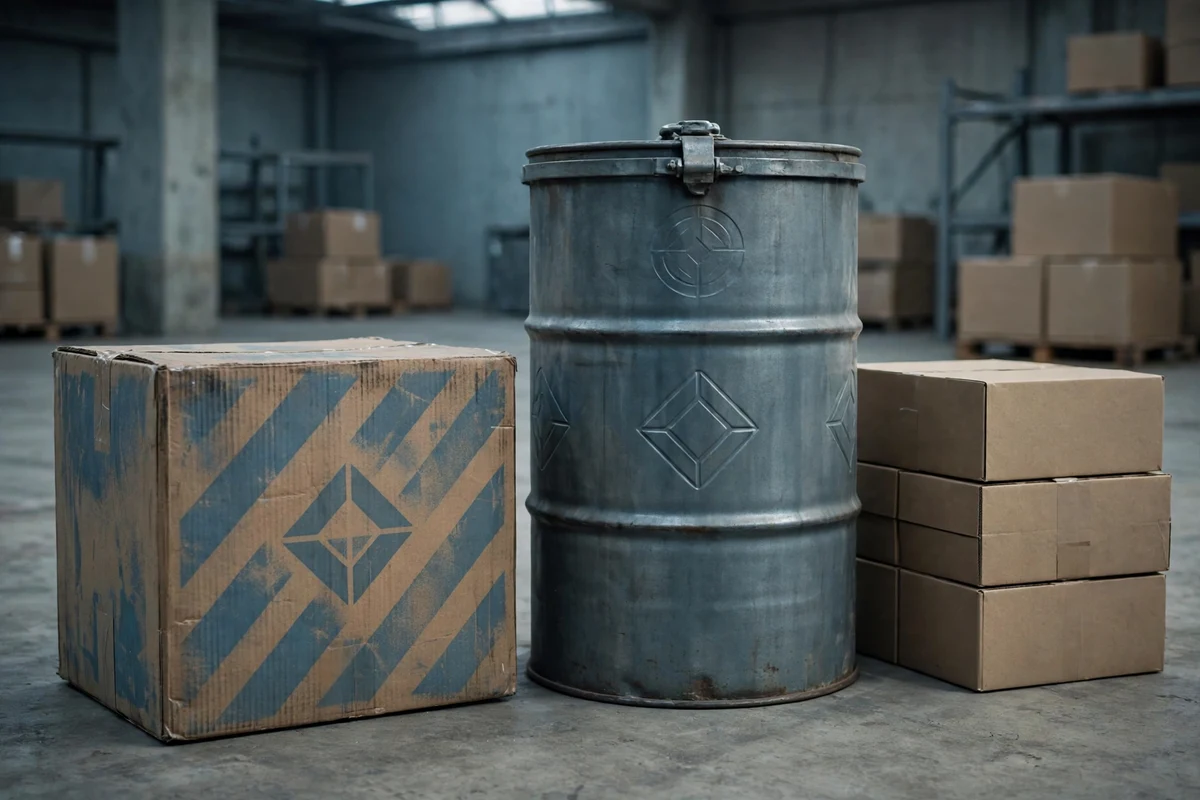
UN-approved packaging is packaging built to a design type that passed the performance tests for dangerous goods and carries the UN mark to prove it. This guide reads the mark, walks the tests, and explains the two certificates behind the DG packaging certificate from China.
How to use this guide
This guide covers UN-approved packaging only: what the mark names, what the tests prove, and what the two certificates attest. It does not repeat the air freight guide, the sea freight checklist or the aerosol carton review.
Work through the five stages in order, and do not close the packaging record before the mark read stands settled. A packaging record closed before the certificate pair stands checked may answer for packaging the certificate never names.
Each stage keeps a record: note the mark, the test record and the certificate pair. A stage with no record is a stage the shipment cannot answer for.
Stage 1 — What UN-approved packaging is, and what it is not
UN-approved packaging is packaging built to a design type that passed a set of performance tests and carries the UN mark to prove it. The mark is stamped, printed or embossed on the outer packaging, and it stays with the packaging. A packaging without the mark has no test record the carrier can read.
The mark names the packaging, not the goods inside it. A fibreboard box, a steel drum, a jerrican, a bag or a composite packaging can each carry a UN mark, and the mark answers for the packaging alone. The shipper confirms the packaging is authorised for the material and used the way it was tested.
Stage 2 — Reading the UN mark field by field
Read the mark in its fixed order, from the opening symbol to the maker. The mark opens with the UN symbol, a circled UN, or the letters UN where the symbol cannot be reproduced on embossed metal.
The packaging identification code stands beside the symbol. The opening numeral names the kind of packaging — a drum, a wooden barrel, a jerrican, a box, a bag, a composite packaging or a pressure receptacle — and the letter beside it names the material — steel, aluminum, natural wood, plywood, reconstituted wood, fibreboard or plastic — with a further numeral for the category. A letter V after the code names a selective testing variation, and a letter W names a regulator approval in place of the standard tests.
After the code stands the performance letter. X names a design type tested for packing groups I, II and III; Y for II and III; Z for III alone. A packaging marked X may hold goods of a lower packing group; one marked Z must never hold goods of a higher one. Beside the letter stands the mass or gravity the design type was tested for: a gross mass figure for solids, a specific gravity figure for liquids. A letter S names solids or inner packagings, and a pressure figure names the test pressure for liquids. The mark closes with the manufacture date, the authorising country and the maker name or symbol.
Stage 3 — The five performance tests a design type must pass
A design type earns its mark by passing performance tests on prototype samples. The drop test drops a filled sample onto an unyielding surface to simulate a fall in handling, and the sample must come through with no leakage and no damage that impairs safety. The stacking test loads a filled sample with the weight of identical packages stacked above it, and the sample must hold its shape.
Two tests apply to liquids alone. The leakproofness test pressurises an empty sample with air to confirm the body and the closure seal hold under internal pressure, and the hydrostatic pressure test fills a sample with water and pressurises it to confirm the body and the closure hold under a higher internal pressure.
The vibration test stands apart: it places a filled sample on a vibrating platform to simulate the sustained shaking of road, rail or sea transport, and it is a capability requirement the maker must meet. Design qualification testing runs at the start of production, and the same tests run again after, so a mark earned on a prototype stays earned only while production keeps passing the same tests.
Stage 4 — The DG packaging certificate: two certificates, in a fixed order
For dangerous goods exported from China, the DG packaging certificate is not one document but two, and the order between them is fixed. The performance certificate comes first and belongs to the packaging maker: the maker sends representative samples of each packaging type for testing, and the inspection authority issues the performance certificate when the samples pass the UN performance tests. The certificate names the UN mark for every package and its own certificate number.
The use appraisal certificate comes second and belongs to the exporter: the exporter applies with a copy of the performance certificate from the packaging supplier, and customs issues the use appraisal certificate after checking the actual goods were packed into certified packaging correctly. An exporter who holds only the performance certificate holds no DG packaging certificate at all. Both certificates are presented together for the maritime DG declaration, and a shipment without both cannot load.
The application runs through the China International Trade Single Window, and the tests behind the performance certificate follow the IMDG Code. Where the goods, the packaging or the packing change after the certificates stand issued, ask the inspection authority in writing before the booking.
Stage 5 — Reading the mark, the tests and the certificate beside the shipment
Before the booking, read the three records beside the shipment: the mark on the outer packaging, the test record behind the mark, and the certificate pair behind the packing. The mark must be durable, legible and placed where the carrier can read it, and a mark worn, smudged or hidden under a label reads as no mark at all. The performance letter must cover the packing group of the goods, and the certificate pair must name the packaging type the shipment actually uses. Where the mark and the certificate read differently, stop and ask in writing.
Reading one carton from the factory floor to the carrier handover: the mark, the tests and the certificate as one record
Take one carton, and read the mark, the tests and the certificate as one record beside it. The carton is a fibreboard box, and the mark on its side opens with the UN symbol, names the box, the fibreboard, and the performance letter the design type earned. The mark alone does not load the carton: the test record and the certificate pair close the record it opens.
Behind the mark stands the test record. The design type behind this box passed the drop, stacking and vibration tests on prototype samples, and the samples came through with no leakage and no damage that impairs safety. The box holds solids, so no leakproofness test and no hydrostatic pressure test stands behind it.
Behind the test record stands the performance certificate. The maker of this box sent representative samples for testing, and the inspection authority issued the performance certificate when the samples passed. The certificate names the UN mark that must appear on every box of this design type, the maximum gross mass the design type was tested for, and its own certificate number.
Behind the packing stands the use appraisal certificate. The exporter applied with the performance certificate copy, and customs issued the use appraisal certificate after checking that the actual goods were packed into certified boxes correctly. The use appraisal certificate answers for this packing alone: the goods in this box, packed in this box, by this exporter. A performance certificate alone never stands in for it.
Now read the three records against the goods. The performance letter on the box must cover the packing group of the goods inside, and the gross mass figure on the mark must cover the load inside the box. A box marked Z beside goods of a higher packing group reads as a mismatch, and so does a box whose gross mass figure falls short of the load.
Read the mark against the certificate pair as well. The packaging code on the box must name the same kind of packaging the performance certificate names, and the maker on the mark must match the maker the certificate was issued to. A mark that names a steel drum beside a certificate that names a fibreboard box reads as two different packagings, and no carrier loads a shipment whose mark and certificate disagree.
A letter V after the packaging code names a design type tested under a selective testing variation, and the box must travel the way it was tested. A box that travels with a different inner packaging than the one named in the test record answers for no shipment. The mark answers for the packaging as tested, closure included, and the seller confirms the inner packaging and the closure before the booking.
All three records read together, and the shipment loads when they agree. The mark names the packaging, the test record proves the design type, the performance certificate proves the maker earned the mark, and the use appraisal certificate proves this packing was done right. The seller, the forwarder and the carrier each read the same three records.
Which packaging record to settle first when the mark and the certificate read differently
A package is settled against the mark, the test record and the certificate pair.
| Label | When it applies | What to do first |
|---|---|---|
| The mark names a box and the certificate names a drum | The mark and the certificate disagree on the packaging | Read the mark, the certificate pair and the packaging together |
| The letter covers a lower packing group than the goods need | The letter and the goods disagree | Read the letter, the packing group and the mark together |
| The gross mass figure falls short of the load | The mass figure and the load disagree | Read the mass figure, the load and the mark together |
| The mark is worn, smudged or hidden under a label | The mark cannot be read at the gate | Ask for packaging whose mark the carrier can read |
| The inner packaging differs from the test record | The inner packaging and the test record disagree | Read the inner packaging, the test record and the mark together |
Why a dangerous goods shipment waits before the packaging read closes
Most holds come back to a few causes. A shipment is sent with no use appraisal certificate beside the performance certificate, so the pair reads with one half missing. A mark is read with no test record beside it, and a packaging code with no performance letter beside it.
The fix is the same in each case: name the mark, name the test record, and name the certificate pair.
Next is a shipment whose inner packaging changed after the test record stood issued.
What this UN-approved packaging guide leaves open for the seller and the carrier
This guide cannot decide whether a carrier will accept packaging the mark and the certificate hold open: the carrier decides, and the seller confirms it.
It also cannot replace carrier, forwarder or inspection authority advice on a specific shipment. Where a carrier names a step this guide does not name, ask the carrier.
It also cannot say whether packaging the certificate never read matches the mark.
Dangerous goods guides on this site
- Dangerous Goods Air Freight from China: Complete Guide
- Dangerous Goods Air Freight Checklist: Documents, Packaging & Carrier Acceptance
- Dangerous Goods Sea Freight Checklist: IMDG Booking & Handover
- Aerosols from China to Europe: Classification, Packaging and Carrier Review
- Lithium Batteries from China to Europe: Ocean, Air and Road Handover Checklist
- Aerosol Carton Packaging: What to Show Before Freight Booking
Related guides
- Dangerous Goods Air Freight from China: Complete Guide
- Dangerous Goods Air Freight Checklist: Documents, Packaging & Carrier Acceptance
- Dangerous Goods Sea Freight Checklist: IMDG Booking & Handover
- Aerosols from China to Europe: Classification, Packaging and Carrier Review
- Lithium Batteries from China to Europe: Ocean, Air and Road Handover Checklist
- Aerosol Carton Packaging: What to Show Before Freight Booking
Official references
- IATA: Cargo
- FIATA: International Federation of Freight Forwarders Associations
- ICC: Incoterms 2020
- US Customs and Border Protection: Trade
- IMO: International Maritime Organization
- GOV.UK: Import goods into the UK
For a route-specific logistics review, provide the product, origin, destination, packed dimensions, weight and ready date.
Request a shipment review ↗Frequently asked questions
What does the UN mark on dangerous goods packaging mean?
The mark confirms the packaging was built to a design type that passed the performance tests for dangerous goods. It names the packaging type and material, the packing groups the design passed tests for, the manufacture date, the country and the maker — and it names the packaging, not the goods inside it.
What tests must UN-approved packaging pass?
A design type must pass the drop test, the stacking test and the vibration test, with the leakproofness test and the hydrostatic pressure test added for liquids. Design qualification testing runs at the start of production, and the same tests run again after.
What is the DG packaging certificate for dangerous goods from China?
It is two certificates in a fixed order: the performance certificate, issued to the packaging maker when samples pass the UN performance tests, and the use appraisal certificate, issued to the exporter when customs checks the goods were packed into certified packaging correctly. Both are presented together for the maritime DG declaration, and a shipment without both cannot load.